
CYCRANE / Continuous-power material transport
Busbar Powered
Transfer Cart.
Fixed route.
Power along the production line.
Move heavy loads along a defined rail route with conductor-rail power. Configure the deck, travel length, supply voltage and collectors around your workshop and operating duty.
- 5–200 tCapacity range
- 20–300 mTravel reference
- 3 / 4 / 5Pole options
- No onboard battery charging
- VFD traction options
- Custom decks & fixtures
 BUSBAR POWERED / RAIL-GUIDED TRANSPORT
Start with the route.Define the load, travel and available power supply.
- 01Load & deck
- 02Route & duty
- 03Busbar & collectors
01 / A power system for a defined route
Keep power on the route.
Plan the whole installation.
A busbar cart collects power from a conductor system along its travel path. It suits fixed-route handling where the rail layout, guarding and power supply can be coordinated.
- 01 / OPERATING DUTY
Plan for shift work.
No battery charging stops. Confirm the intended operating hours, starts and maintenance plan for continuous-duty applications.
- 02 / POWER SYSTEM
Choose the conductor.
Insulated conductor rail or guarded open-bar arrangements, with 3/4/5-pole selections for engineering review.
- 03 / FIXED ROUTE
Connect the process.
Define the travel length, loading stations, expansion joints and access around steel, assembly or warehouse operations.
- 04 / LOAD SUPPORT
A deck for the task.
Discuss coil supports, mold fixtures, platform height, loading method and load restraint.
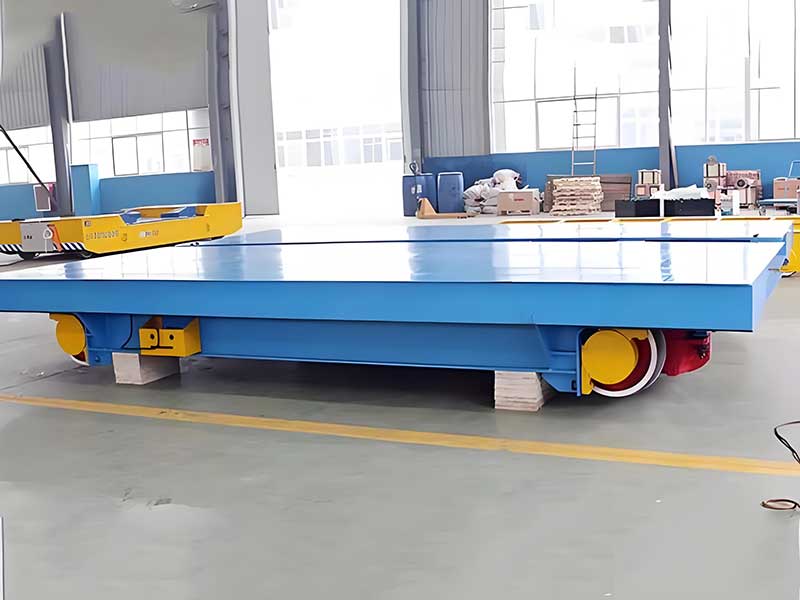
02 / Configure your busbar transfer cart
Define the cart.
Review the power system.
Adjust the 17 original configuration choices. Your indicative EXW budget, electrical planning figures and complete enquiry update together.
Build Your Spec
Start from the sample configuration. Current class, collectors, protective earthing and the route require engineering review.
Conductor and collector selection require engineering confirmation.
03 / Technical reference
Chassis and conductor rail.
One coordinated specification.
Review the original specification range against your route and site power. Protection, test scope and documentation are confirmed in the proposal.
| Type | Busbar powered transfer cart (insulated conductor rail or open bar) – rail‑guided |
|---|---|
| Rated Capacity | 5–200 t standard (custom on request) |
| Deck Size | 3–12 m length × 2.0–4.0 m width; custom fixtures on request |
| Travel Length | 20–300 m typical (straight); segmented routes with expansion joints can be engineered |
| Poles | 3/4/5‑pole systems (3Ph, 3Ph+PE, 3Ph+N+PE) |
| Voltage | 380/415/440V, 50/60Hz, 3Ph |
| Current Classes | 100–500 A typical; higher on request |
| Collectors | Single or dual per phase; guarded, sprung shoes |
| Protection | IP23–IP54 rail covers; interlocks & emergency stop |
| Max Speed | 8–40 m/min (VFD) |
| Control | Pendant / Radio remote / Cabin |
| Duty Group | ISO/FEM M3–M5 |
| Finish | Industrial epoxy; outdoor C3–C4 paint system |
| Docs | CE/ISO documentation requirements and FAT load / functional test reports: confirm applicable scope in the proposal. |
Higher capacities and special requirements can be discussed. CE / ISO documentation, FAT reporting and the original one-year warranty are confirmed within the agreed contract and supply scope.
04 / Fixed-route applications
Connect the workstations.
Match the deck to the load.
Plan loading and unloading positions for steel, molds, coils or assemblies. Product photographs illustrate cart platforms; the project drawing defines the final power installation.
Heavy loads along a defined path
Confirm platform dimensions, load support points, rail alignment and transfer stations.
A coordinated workshop installation
Review conductor position, collector access, guarding, feeds and maintenance clearances.
05 / From enquiry to commissioning
Review the installation.
Agree the complete scope.
Coordinate cart drawings, conductor layout and electrical protection before ordering. Testing and site services are confirmed in the proposal.
- 01 / SIZING
Load & route.
Share capacity, deck, travel and site power.
- 02 / PROPOSAL
Layout & budget.
Review cart drawings, conductors and feeds.
- 03 / MANUFACTURING
Build & test.
Agree load, current and protection test scope.
- 04 / DELIVERY
Pack & ship.
Confirm crating, logistics and documents.
- 05 / COMMISSIONING
Check & hand over.
Confirm site checks, training and maintenance guidance.
06 / Useful busbar cart questions
Before you specify
a busbar transfer cart.
Start with your load, fixed route and available power supply. We can review undecided details with you.
Discuss your route ↗When should I consider busbar power instead of a battery or cable reel?
Busbar power is an option for a defined rail route where a conductor system and protection can be installed. It avoids onboard battery charging. Compare it with battery or cable-reel power using your route, access, travel distance, duty and installation cost.
Does conductor-rail power guarantee 24/7 operation?
No. It removes battery charging from the operating cycle, but actual availability depends on the site supply, duty rating, protection, maintenance and installation. Specify your intended shift pattern for review.
How do I select poles, voltage and current class?
Share your site supply, loads, duty and protective-earthing requirements. The choices are enquiry inputs. Final conductor size depends on current, voltage drop, thermal limits, feeds and protection. A 3-pole choice still needs a suitable PE arrangement.
Do dual collectors increase the busbar current rating?
No. The original planning model provides a collector review prompt. Collector performance and conductor rating are separate checks; dual collectors do not make an undersized conductor acceptable. Confirm the complete electrical design with the project team.
Is the displayed busbar length a final material list?
No. It retains the original travel-length × 1.15 planning allowance. Feeds, joints, expansion arrangements, end caps and actual route geometry must be determined from drawings.
What does the displayed budget include?
The main range is the indicative EXW equipment budget for the selected number of carts, using the original configuration model. Multiple carts show an equivalent per-cart range. Final conductor supply, installation, freight, tax, price and schedule require commercial confirmation.
07 / Your busbar cart enquiry
Tell us the load.
Show us the fixed route.
Your selected specification, indicative budget and electrical planning figures are included with your enquiry. Add your destination, site power and project requirements for review.
- WhatsApp / phone+86 155 1554 5327
- Sales enquiriessales@cy-cranes.com
- Talk about your projectCall +86 155 1554 5327
Useful files: load dimensions, rail layout, station positions, conductor route and site photos. Include available supply voltage, daily operating hours and known protection requirements.
Request a Busbar Powered Transfer Cart Quote
Start with your email and destination. Add the project details you already know.
Review the configuration included with your enquiry
Prefer email? Send your configuration ↗