
Workstation lifting · Configured for your site
Wall-Mounted
Jib Crane
Create a lifting zone without a floor-mounted pillar. Configure the wall jib around your load, working radius and available wall or column structure.
Tie-rod or cantilever boom · Manual / electric motions

Keep the workstation floor clear.
Use a wall or column-mounted boom for assembly cells, machines and line-side stations. Check the swing envelope and available supporting structure.
Choose the motions you need.
Manual travel for simple positioning, or electric trolley and slewing options. Select hoist speed and headroom for the task.
Match the brackets to the structure.
Select a steel column or reinforced-concrete wall mounting. The supporting structure, brackets and anchors need a project-specific capacity review.
01 / Configure your crane
Your workstation.
Your lifting specification.
Choose your project requirements. The selection summary and budget update together, ready to include in your enquiry.
Crane configuration
These are enquiry parameters. The maximum capacity, outreach and height are not guaranteed to be available together. Final design, supporting structure capacity, brackets and anchors require technical confirmation. Requested timelines are subject to production availability.
02 / Workshop applications
A dedicated lifting zone
around your process.
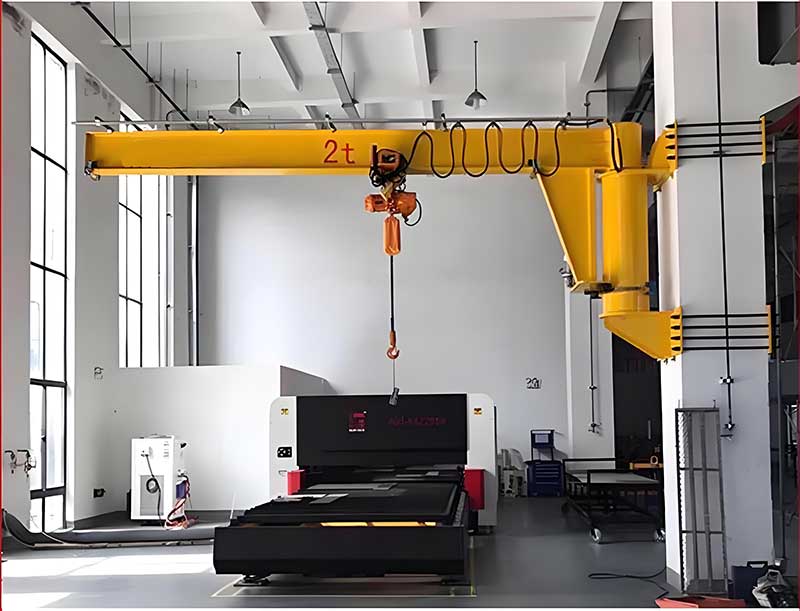
A wall jib provides local lifting coverage along the production line without a dedicated floor pillar. Check wall or column capacity, bracket spacing and obstructions before selecting the arrangement.
- Assembly & maintenancePosition components, tooling and service parts within the work cell.
- Machine loadingMove workpieces between a staging point and the machine.
- Packing & material handlingSupport repeated lifts at defined transfer or packing stations.
03 / Technical reference
Wall-mounted jib crane specifications.
Use these ranges to define your enquiry. We will confirm the compatible capacity, outreach and height for your selected design.
| Crane type | Wall-mounted / wall-bracket jib crane |
|---|---|
| Rated capacity | 0.25–5 t; rated load and outreach are selected together |
| Boom outreach | 2–10 m, subject to configuration review |
| Under-boom height | 2–8 m; usable hook height depends on hoist headroom |
| Slewing range | 180° / 200° / 270° |
| Slewing & trolley | Manual push or electric drive |
| Boom options | Tie-rod (overbraced) or cantilever (low-headroom) |
| Hoist | Electric chain, single / dual speed (VFD); wire rope option |
| Mounting | Steel column or reinforced-concrete wall; through-bolts/backing plate or chemical anchors, subject to structural review |
| Power supply | 380V/50Hz/3Ph; 415V/50Hz/3Ph; 460V/60Hz/3Ph |
| Power feed | Festoon cable or energy chain; power-feed arrangement matched to the swing range |
| Duty group | ISO/FEM M3–M5, selected for the application |
| Safety configuration | Overload limiter, slew limit stops and emergency stop; confirm the supplied scope |
| Finish | Indoor epoxy; outdoor C3–C4 system; clean-area options |
| Other options | Low-headroom hoist, radio remote, stainless hardware, lighting |
Project-specific duty classification, documentation, safety scope and installation requirements are confirmed in the proposal. Hazardous-area configurations require a separate review.
04 / Project workflow
From your requirements to a site-ready plan.
- 01
Sizing
Load, outreach, height and wall / column details.
- 02
Proposal
Crane layout, mounting plan and quotation.
- 03
Manufacturing
Production and agreed inspection / load test.
- 04
Delivery
Packing and logistics for your destination.
- 05
Installation
Approved brackets / anchors and installation guidance.
Before you order
Practical questions.
Clear requirements.
Can the crane be fixed to any existing wall or column?
The steel column or reinforced-concrete wall must be checked for the crane loads. Send structure dimensions, drawings and site photographs. The supporting structure and anchor arrangement need approval before installation.
Is under-boom height the same as lifting height?
No. The hoist and trolley take up headroom below the boom. Tell us the required hook height and available ceiling height so the layout can be checked.
Should I choose a tie-rod or cantilever boom?
Tie-rod and cantilever designs have different support and headroom requirements. Send the available clearance above the boom, bracket positions and required hook height so the design can be reviewed.
What does the budget estimate include?
It is a planning estimate for the selected crane quantity on an EXW basis. Freight, duties, civil works and installation are excluded. The final supply scope and price are confirmed in the quotation.
What information should I send for a firm quotation?
Provide capacity, outreach, under-boom height or required hook height, power supply, quantity and destination. A layout photo or drawing and wall / column details help us check coverage and mounting.
Can this be used outdoors or in hazardous areas?
Select the environment and describe the conditions. Outdoor coating, electrics and hazardous-area requirements need a separate technical review. An anti-spark option alone does not establish explosion protection.
05 / Request your proposal
Get a quotation
for your workstation.
Send your requirements for a crane layout, equipment price and lead time. Your selected configuration is included in the form below.
For a mounting review, prepare your wall or column drawings and dimensions.
For a coverage check, send a workshop layout or site photograph.
Documents and any special requirements can be emailed directly.
General enquiries: info@cy-cranes.com
Tell us about your project
Contact name and email are all you need to start.